Showing posts with label bad movies. Show all posts

Thursday, August 19, 2010

The Spy Who Loved Me

Many stupid Bond fans think this is a decent movie. It ain't. It's on TV now, and I want to comment via live-blogging.

"The Spy Who Loved Me" was made during the plot-rails Roger Moore era. His plots usually were driven by the external Hollywood need to have exciting action and not to follow earthly human reason. Basically, the series had gone on long enough that the writers/producers stopped making 'spy thrillers' and just made 'Bond films' (which meant: gadgets, exotic locations, and weird fights).

The movie's premise is stolen from You Only Live Twice - e.g. a third party terrorist kidnaps vehicles from the US and USSR in order to induce WWIII - and this includes the fun 'major army takes over kooky evil man base.' That's good, no question, but it's derivative. And YOLT was better because (a) it was first, and it had (b) Connery, (c) ninjas and (d) a volcanoo. Also, the plot point of a eugenicist billionaire was recycled for the next, and even worse, movie (Moonraker).

But a key problem of recycling from YOLT is that while that movie used a spaceship to swallow up other (US/USSR) spaceships, TSWLM has a big boat swallow up submarines. OK, so lets see how the premise doesn't carry. In 1965, spaceships were basically just non-maneuverable orbiting bricks and so there's some logic that they could be kidnapped by being swallowed from behind.

But submarines being swallowed by a surface ship? They are called submarines for a reason. They just need to go DOWN! And if thinking in 3-dimensions is too hard for Hollywood writers (I assure you, all mariners and aviators are trained to do so, but hack writers can't) then the submarine still has guns and torpedoes! Shoot the frickin' boat before it swallows you! It's what they sub does at the end of the movie when it needs to escape, so it's not like they didn't know about guns in their planet.

Also, each ship was kidnapped because the bad-guy wanted their nuclear weapons (which, unbeknownst to the crew, were to be launched against all major world cities - in a purposeful plan of world annihilation). That's a quite crazy plan, admittedly, but I believe that all nuclear sub crews would kill themselves willingly than let their subs be captured by a hostile - because even one rogue nuke is a world nightmare.

Logical, no? So when the submarine is swallowed by the supertanker - by sitting there on the surface, like Tanya Roberts being kidnapped by a blimp in "A View to a Kill" - and Stromberg threatens to kill the crew with cyanide, they all give up. Why?! Given, the dire nature of captured nukes, they should never had been there in the first place and should also fight to the last man.

Anyway, skipping to the end: after Bond succeeds in diverting the nuclear missiles, and enjoys some success, suddenly the ship starts exploding - forcing their escape. Why?! There's no actual cause for the explosion! Except, as they say on TV Tropes, it's made of explodium.

Hollywood Idiocy: The Showdown

At the end of the movie, Bond asks the Pentagon to hold off destroying Stromberg's base so he can save Anya. Bond builds a jet ski (seriously; even though the sub has to go the base anyway in order to shell it - this is a worthless action by Bond) and then sails to Stromberg. When he shows up, Stromberg tries to kill him with the elevator, but Bond outsmarts him (it's dumb). Then Bond, gun drawn, confronts Stromberg - asking him where Anya is. Stromberg doesn't say and instead he asks Bond to sit down... and Bond does! Why?!? He has only a few moments before the sub shells the station, and he sits down?!

Ah, it's because the plot requires it. Ya see, Stromberg has a clever device - a gun that is immobile and only can kill someone if you're sitting in JUST THAT CHAIR, and so Bond is forced to sit there. Oh, the gun has only one shot. So Bond sits down, Stromberg pulls the trigger, and Bond jumps up before the bullet - made of marmalade? - travels down the bullet tube. OK, so then at that point Bond gets angry and kills Stromberg by pointing the gun in the exact tube and firing - thus shooting Stromberg in the gonads.

Do you understand the logic in all this? Bond kills Stromberg - which he could have done when he came in, but waits to get some info - and after Stromberg is disarmed... Bond shoots him anyway. Stupid and pointless. It's only there to allow Bond to blast the bad guy in the nuts.

Anyway, earlier in the movie, Stromberg recognizes Bond as an enemy agent. Earlier in the film, Stromberg kills some scientists by dropping them through a false bottom in his elevator. He doesn't do this to Bond. Rather he lets Bond go and tells Jaws to kill him outside the ship. Why? Stromberg was already willing to kill people in his own ship before. The only reason to do this is to create a chase scene. Which hurts my brain!

And Jaws' plan for killing Bond? To send a motorcycle equipped with a rocket propelled bomb disguised a sidecar. Which of course misses. Then, when that fails, Jaws chases after Bond in a car - shooting at him with a pistol. Then when that doesn't work, he has the best looking Bond babe ever (seriously), named Naomi, shoot at Bond with a machine-gun toting helicopter.

Now, I'd like to explain how a person is supposed to write a fiction plot: there's supposed to be a correspondence to how people in the actual world think and act or otherwise people (like me) cannot suspend our disbelief - because logic is the food of consciousness. Without logic, my brain rebels.

OK, so according to the writers, Stromberg, the genius billionaire's, plan is to not kill Bond in the same secret untraceable way which worked before but instead to do so in public using a wildly untested method of unguided remote control sidecar explosives. Why? So it would look like an accident? And he said to himself "We'll use the sidecar bomb and even though it's foolproof, you Jaws should follow after him in a car and shoot at him with a pistol - even though shotguns are better at that range and for hitting moving targets, and we doubtless own shotguns if we can purchase or manufacture a custom made motorcycle bomb.... Oh, and above all, surveillance will be from a highly effective helicopter, used the world over to destroy tanks, and it will only be used if my idiotic stuff fails."

Nope, nobody but an idiot - or a Hollwywood writer - would use their resources in this manner. It's only there to create a chase scene modeled after a video game; that's all. and it hurts my brain. The fact that people like this movie is as explicable as people liking the latter Lucas films - most movie-goers, even the nerds of TVTropes - do not possess logic sensors in their heads.

Note, every single problem I've just elucidated, is present from the very first minute in Moonraker, which starts with Jaws surviving a free fall from thousands of feet because he lands on a circus tent... and goes downhill from there. A similar live-blogging of that movie would burn up my keyboard.

Second pic from here.

Friday, July 30, 2010

Fletch on Movies

As part of my Shabbat/convelescent reading, I've been going through the "Fletch" novels of Gregory McDonald. Like every red-blooded Genxer, I was introduced to Fletch via the movie, which I often put in my top 5 favorite movies. The first book has basically the same plot skeleton, but is not nearly the same level of comedy, as the film. I will have more to say about the books soon, but I wanted to jump the topic with a quote from a later book in the series, "Fletch's Moxie" which is about the movie business. McDonald sets his books in different 'worlds' and will go on a particular author-filibuster on that subject (e.g. the art world, journalism, politics).

"Moxie" is about movies and actors, and the following speech is a wonderful description (something I wish I'd written) about the terrible 'message movies' that usually win Best Picture, and what is mistaken as 'serious' filmmaking:
"I’m just reading this filmscript.” Fletch jiggled his knee under it. "I don’t know, of course. Never read a filmscript before. It strikes me as pretty terrible. The characters all seem to be like people you meet at a cocktail party—all fronts and no backs. They don’t talk the way people really talk. I do a little writing myself—on days when there are hurricanes. It seems to me, in this filmscript much time and space are wasted while the author is floundering around trying to arrive at an idea. All that should be cut away. Don’t you think writing should begin after the idea is achieved?" Mooney was looking at him like a bull bored with the pasture. "It treats controversial old issues in an insulting, offensive way. Instead of trying to create any sort of understanding, my reading of it is that it is trying to provoke hatred—deliberately."
Apply this to any number of the Best Pictures of the past decade (e.g. American Beauty, Crash, Million Dollar Baby, anything by Ron Freakin' Howard after Apollo 11).

Friday, January 09, 2009

Brief Movie Notes: The Dark Knight (2008)


I hated this movie on so many levels. I have much to say but it's taking a while to make it coherent. To substitute for me, read the 100% correct review by David Edelstein of New York Magazine. The original review, and his response to the drooling idiots who attacked his negative review.

Image nabbed from here.

Thursday, December 04, 2008

Law & Order


Since moving to Boston, we inherited two televisions with the house. Each is connected to cable (a necessity here). One TV is in the basement and is pretty much permanently affixed to PBS-Kids (and/or a running loop of Thomas the Tank Engine videos). The second TV is in our bedroom (remember, we inherited this setup) and is also permanently affixed to a station, in this case TNT. Why? Because my wife looooves "Law & Order." Luckily, it can be broadcast three or four times a night and since it's been on TV since the fall of the Berlin Wall, there's plenty of episodes to show.

We watched the show often, since our time in NYC. However in recent years I've found the show to be harder and harder to watch. The formula has become tiring. First of all there are the factual implausibilities: the level of murder in L&O-Land makes Manhattan look like Baghdad, the DA's staff have only two prosecutors, and the fact that the late seasons had the Manhattan DA (who has been a liberal Jewish Democrat for the past 300 years) as a cornpone Tennessee Republican cracker.

But the formula goes as such: (1) Before the opening credits is some grisly murder 'torn out of the headlines' (which is OK as a premise, I'm not criticizing this part as much as categorizing); (2) the police procedural which ALWAYS has a red-herring. Always. Jeez! The cops go after some generally skeevy dude and it's always wrong. Finally the real culprit is unearthed and it's often tendentious (it's the way cheap mystery writers create the sense of the unknown by either defying logic or by not giving you enough info). The green herring (as opposed to red), the real culprit, is usually a B-list movie star - a quick hint for the fourth wall viewer (3) The DAs are brought in and since the perpetrator is clearly guilty (sporting swastika tattoos on their forehead or what have you) the case must be made artificially suspenseful by having a major piece of the evidence thrown away on some technicality ('suspense' in L&O in the "Order" portion is as fictive and false as the 'mystery' is in the "Law").

This part generally causes me to leave the room in frustration. I just don't like being force fed images of stupidity. It's almost equivalent to the parts of late Dirty Harry style 80s films when the judge allows the serial-rapist to go free because the arresting officer read him his rights while hepped up on Twinkie filling.

The 'Suspense' is fake, false, and insulting... and the rest of the case proceeds from that handicap; the ADA needs to prove the killer shot his grandmother but the gun was ruled inadmissible because it was made out of pressed-together Korans. Whatever. The 'suspense' also violates the basic rules of narrative: a story makes sense for real reasons.

The L&O from the other night was a beaut: (1) the death is of a woman who was stoned to death (religion? maaaybe). (2) The red-herring was a set of Albanian Muslims who were known to be violent against immodesty (the victim was an art show producer who was showing pictures of Muslim violence against women). (3) The herrings are given an airtight alibi by the FBI (who have put the group under watch) but who happened to be investigating the murder victim because of NSA warrantless wiretapping; ya see, she was talking about "jihad" over the phone (and that was the theme of the art show, har har). However, lucky break! The FBI wiretap overheard that the victim was having an adulterous affair with the Muslim artist whose work she was going to show! Aha!

Now, so far, the writers have developed three very provocative plot directions but since we're in the throw away section of the show, none of these will be used again. Some people could look at this as a sign of the salubrious artistry of the screenwriters. But smart people (like you and me) will recognize that each part is salacious tabloid exaggeration - things that just don't really exist in real life and especially in close proximity to each other. No matter. It's all in the bin, for now we find out that the victim's son is the culprit.

He's discovered through another set of tendentious links. The victim's husband failed to mention to the cops that his son is a paranoid psychotic who has been brainwashed by an Evangelical pastor (played by a B-list Movie Star, Samwise Gamgee and/or Rudy depending on your age) into believing he was a messiah. The pastor convinced the killer to stone his mother to death because she committed adultery (bad) with a Muslim (badder).

OK, so basically, in the real world the killer and his pastor will be arrested and put behind bars. But not in Law & Order! Ya see, the killer claims he has visions from God and has a psychiatrist prove that his brainwaves change while he's under prophecy and the judge accepts this proof to say that the killer can't be held guilty while he's acting our prophecy.

Uh, yeah. Sure. Why is this even put on television? Well, after the regrettable few years of Fred Thompson as the Manhattan DA, the ultra-liberal writers are able to explain over and over that Americans hate Muslims so much, and love Christian wackos so much, that anything Christians do - especially violence against Muslims - will be considered acceptable to a Manhattan jury.

Maybe, maybe, if the show were set in Lubbock, Texas I'd have an easier time accepting that premise (as well as the huge yearly body count). But not in Manhattan. And you can say that I'm taking this too seriously. I am, I guess, but only because I watched it with my own eyeballs and I'm taking out vengeance for it's insult to my cranium. However, the response to people who accuse me of 'too seriously'-ism, you have to answer why fiction should be allowed to be not only stupid and incoherent (which I can basically live with) but also to teach bad moral lessons? To suggest that the world is actually much more of a hateful place THAN IT ACTUALLY IS.

I remember my reaction to the horrid little film "Wag the Dog" which indicted all Americans as credulous and easy to fool. Some even have put the proof of this movie on the Iraq war, to say that we bought those lies just as the movie predicted. NO! People bought the Iraq War's lies because (a) we had just been attacked on 9/11 and so people were jumpy about enemies, especially known psychopathic ones, (b) the government made the case using false information that Iraq was both responsible for 9/11 and that Saddam was preparing nukes against us... and the Press helped pass along these lies, (c) when the lies became clear (in 2005 or so), the nation moved firmly against the war (cf. the 2006 & 2008 elections).

Wag the Dog was evil back in 1997 because of the mean-spirited lies that it claimed were truths; for the accusation that people are scum. Law & Order, in its worst episodes (they're not all bad, only in the last few years when they ran out of ideas), does the same thing.

In the above episode, the court case proceeds against the pastor and - luckily enough - the police are given hours of incriminating videos of the organization which just happen to have been taped by one of the pastor's camp-counselor. Ya see, the pastor has been running a Christian-style madrassa that teaches 8-13 year old kids to fight a war against Muslims (even showing the kids in camouflage clothes and camo face-paint). And two kids went along with the killer and helped stone the mother to death. And in the full court the pastor starts screaming about how holy-war against the Muslims was necessary and that he agrees with what the killer did.

Yet he's acquitted. Why? Because Americans hate Muslims because Americans are so totally Christian. Proof? One of the jurors was caught reading the Bible for help in the deciding the case and he's dismissed as a juror!

The lessons learned are infuriating and insulting. Accept better.

Update Postscript: It's this same misanthropy that makes me also hate "slasher" horror films. The whole genre just hates people, and so do shows like this.

And I had a spare moment and found the name of the cruddy L&O episode I tore apart above: "Angelgrove." And to show you what I'm up against, here's the comment of some doofus IMDB member:
the story of a boy stoning his mother was compelling. I knew the Christofascists had Jesus camps in this country, but I never suspected that we could have Islamofascist-type Madrassas to indoctrinate the youth into killing for Christ. One would have to be completely clueless to suspect that a jury would convict in this case. Of course, the prejudices of the average juror would compel them to let this wacko go.
Sigh.

Sunday, April 13, 2008

Kevin Smith & George Lucas

The Onion AV Club has a feature "The New Cult Canon" (which is about what you'd think) and Scott Tobias' entry on Kevin Smith's Clerks (IMDB Wiki) is about as scathing a summary of why Kevin Smith sucks as it should be. I remember hearing the buzz and then seeing the movie and wondering 'why is this any good?' The acting is atrocious and the dialogue was depraved. The rumor that it almost got an X-rating for language has an empirical basis.

Tobias is also correct about the well-known Death Star scene, whose decent dialogue was ruined by the painfully bad acting:
O'Halloran and Anderson aren't skilled enough as actors to serve as more than mouthpieces for Smith's lowbrow gags and bits of philosophy, and they often choke on his reams of dialogue. (Smith has always been praised for his tart screenplays, but to me, he's a writer much too in love with his own voice; his films are littered with scenes that are allowed to drag on several beats longer than they should.)... That said, even Anderson can't trample over this fine monologue about the destruction of the Death Star in Return Of The Jedi:


It's (unwittingly?) ironic that Smith talks about Lucas because both of them share the same directorial trait: that while they may know where to place a camera directing is also how to get the actors to do what is necessary to be good actors. And while I can't necessarily argue about their camera skills, neither Smith or Lucas's actors come off as convincing. How else could Natalie Portman be horrible for Lucas yet in the same year be nominated for an Oscar in another film?

Backpost; put up 11-10-2009. Pic from here.

Wednesday, January 23, 2008

My Year Of Flops, The Year In Review

If you recall, I've found Nathan Rabin's column, 'My Year of Flops' incredibly good reading. Even when he was totally wrong (he didn't like Hudson Hawk or even Mystery Men), he was worth reading. Here he ends the bi-weekly column, but pledges to continue it monthly (which is not enough, but he may have been running out of flops).

Backpost finished 4/8/08. Just the link.

Friday, August 10, 2007

More Like the Flops

Two other websites that deal with bad movies from a smart perspective:
  1. Jabootu's Bad Movie Dimension

  2. And You Call Yourself a Scientist
Both are good reads but not as astute, or redemptive, as Rabin's stuff.

Tuesday, August 07, 2007

Great Reading: My Year of Flops

In the past three or four years the number of must read websites has exploded (at least for me). Sometimes I'll stumble upon a series that eerily meets my interests with such focus that I need to absorb the whole corpus. The latest in that string of 'must reads' is Nathan Rabin's Onion AV Club column: "My Year of Flops"

Thursday, August 10, 2006

Little Voice (1998)

We saw Little Voice (1998) last night. Please heed my warning, do not see this movie.

It combines these two genres:
  1. Quirky British Natives (it's made by the same bloke who gave us "Brassed Off")
  2. Plays converted into Movies.
Because its British, the dialogue is incomprehensible; and because it was a play:
  1. Everyone is an exaggerated caricature,
  2. The characters do horrible, inexplicable things to each other,
  3. The movie has A MESSAGE
  4. and what could have been a fun movie with a happy ending is a tragic play with catastrophic results.

You have been warned. If you want to see quirky British caricatures behaving comedically with a happy ending, rent "Wallace & Gromit."

Pirates of the Caribbean 2 (2006)

We're celebrating our anniversary; so we saw an actual movie in an actual theater. Since it's summer, we saw a Bustblocker: Pirates of the Caribbean 2: The Shameless Sequel

There were some great lines, by Depp. There were some great, well-thought-out action sequences. In fact, there was a good movie lurking under all the massive piles of donkey-doo. But the donkey-doo won out.

An apt review comes from Michael Atkinson of the Village Voice:
Of course it's only a summertime sequel, an overinflated, plot-contrivance-by-committee, cheap-shot leviathan, big and graceless as a rusting luxury liner, referencing its hit source movie as if it were a holy gospel, distending gag routines that flopped like a snapper on the dock the first time around. But you were expecting . . . ? The good news, in a season of dire portents, is that Pirates of the Caribbean: Dead Man's Chest is even more of a party-hearty-Marty potlatch of silliness than its predecessor. The franchise having been established, Verbinski, Bruckheimer, and Co. have been liberated to indulge in absurdities, pile on the so-old-they're-new-again clichés, and make jokes at their own expense.

There's not a self-serious bone in the movie's body. It's an assembly-line truffle, but someone was determined to break the genre bank. The stew includes a cannibal tribe, a voodoo queen, a ship-consuming monster cephalopod, the Flying Dutchman, Davy Jones's locker, the infamous East India Company (as the ultimate corporate villain), and a cannon-blasting sea battle, and in the process fulfills, in a goofy-face-contest kind of way, the promise of all pirate movies going back to 1917's Betty and the Buccaneers. It's pure matinee make-believe, high-spirited and outlandish and pleasantly grotesque, if, unfortunately, too long and too Dolby-atomic groady for the little kids who might appreciate it the most.

The story that holds this gibbering nonsense afloat involves a magical compass, the ambitions of British colonials, and a tangle of supernatural curses, rules, and debts centering around the rather spectacular presence of Jones (an all but unrecognizable Bill Nighy), the undead captain of the Dutchman's crew of barnacled crustacean zombies, and himself a Scottish-accented squid-head demagogue with a giant lobster claw and a penchant for playing his Nemo-like organ with face tentacles. The series protagonists cannot compete with Nighy's briny godling and Naomie Harris's rasping swamp witch; Johnny Depp's Keith Richards routine, seemingly even rummier now, is still thin shtick, but he's merely the comic relief who finds himself, to his annoyance, standing inappropriately at center stage. Keira Knightley and Orlando Bloom remain line-reading Sleep-Eze, less functional or effective than Kevin McNally as the Black Pearl's put-upon first mate and official
POTC empathy point.

Naturally, the filmmakers have no idea where or when to stop; in the more forgiving theatrical marketplaces of yore, this could have, and would have, been two or more smaller movies. But if the many octopod Kraken attacks are one deafening digital crash-up too many, they're still a merchant-ship-era folklore iconÂ?here there be monstersÂ?come to fantastic life. The ingredients for a movie-movie tropical vacation are all here, including the boozy highs, the chintz, the wandering waste of time, and the hangover.
I am The Styx and I approved that message.

Monday, January 23, 2006

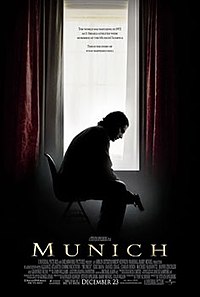
Munich Madness, part 1

This will need to be brief because I actually have too much to say. Back in 2005, Steven Spielberg, King of the Jews (with all that title entails) decided that his years in higher education (baccalaureate from film school, which, admittedly, is better than Clown College), gives him the authority, nay, the responsibility to comment on the Arab-Israeli conflict.

We know from the fact that he is (1) rich, (2) not-religious, and (3) married a bunch of non-Jewish women, we shouldn't expect that a movie about Israel will not be favorable to the Jewy Jewish State for Jews. And we'd be right.

Munich (2005) is based on a fictional account, written as non-fiction, of the aftermath to the massacre of Israeli athletes at the 1972 Munich Olympics. But because the book source wasn't false enough, Spielberg needed to fake it up with a whole bunch of stuff that insults the memories of the victims of the tragedy, insults Israel, and all in the service of making a simple grade-school morality point: there's no such thing as good violence.

Well, I didn't have the time to waste watching the film before talking about it from the pulpit. Rather, I adhered to the "Silence of the Jesus Lambs" Rules which state that you don't have to sit through a movie if more than 90% of eyewitnesses, including many you trust from other encounters but including ordinary neutral parties, all agree. People from all walks agreed that The Passion was a blood-orgy of anti-Semitic hate. And even though Mel Gibson was a known tee-totaling philo-Semitic philanthropist, the eyewitnesses spoke as one.

So too with Silence of the Munich. Many trustworthy sources said that it was mean, stupid, hokum. And so I based my sermons on their words, including this fine analysis by Rabbi Benjamin Blech.

The key point of Rabbi Blech is that Spielberg uniformly distorted events, and then just made stuff up, in order to broadcast a dishonest agenda:
Too bad the movie does not include perhaps the single most relevant dialogue in Jonas' book, Vengeance, that served as the primary source for Munich. In assigning the mission, the agents are given clear instructions: If you get all of the names on the list, your mission is an incredible success. Get six or five, we will feel the message has been sent that Jewish blood is not cheap, that we will not sit idly by as the world did during the Holocaust. Even if you get only one or two, it will not have been in vain. But if you will be faced with a choice between killing any one on the list together with an innocent bystander or aborting your mission, your instructions are to do nothing.

That piece of information is probably the most crucial difference between the Munich terrorists and the Israeli hit-squad, yet it wasn't included in the film.

Munich concludes with a final insult: The disillusioned leader of the mission, who cannot abide the ideology of a country that dares to declare that it will no longer idolize the glorification of the Jew as victim, renounces his country and settles in Brooklyn. And so ends the hope of the Jewish people.

It never happened. And it makes whatever message Spielberg sought to bring to the screen indefensible.
Part 2 of this topic will deal with my reaction to actually seeing the movie.

P.S. I do like the fact that after insulting the memories of the victims of the Olympic massacre, Spielberg becomes part of the Beijing Olympics committee. His moral compass was shattered, and who knows when. And, yeah, he pulled out of the committee a few months ago in protest over the Chinese complicity of the genocide in Darfur. Bra-effing-O Steve. You're a real hero.

Backpost finished 4/13/08, 9:11 PM. I had just the link to Blech's article.

Tuesday, October 21, 1997

Life in the Styx, vol. IV, no. 10 (Old Styx)

Happy Sukkot in the Styx,

CONTENTS
  1. Anniversaries
  2. Seven Samurai
  3. The Top 5 Movies
  4. Cholent-ology
  5. John Denver
  6. Guiliani & Columbus Day
  7. Israel & Extradition
  8. Arab Armies

ANNIVERSARIES

Sunday (10/19) was the 10th anniversary of the Stock Market crash and Monday (10/20) was the 20th anniversary of the Lynyrd Skynrd plane crash.  Related? Let me see... "Freebird" is the greatest guitar rock song in history and was used in a small but crucial scene in "Forrest Gump" (which, remember, I consider a deep movie; although I am having second thoughts after seeing "Contact") to exemplify the ethic of the 70's. The 70's transformed into the 80's just with a steely reptilian packaging and it took the Stock Market crash and the S & L crisis to whup the 80's back into its greasy grave. Tight. Very tight.

The crash enters into the pantheon of 'critical events' of the 80's and as such my formative youth (don't get me wrong, I prefer to have been raised in the 80's than the gutless whiny 90's or the stringy, bell-bottomed out 70's); the crash is up there with the Challenger Disaster and Reagan getting shot as events you can answer the "Where were you when you heard..."

For the record:
  1. Stock Market: at the end of 7th period, PB's Western Civ class, Ithaca High School; from B. Dunham
  2. Challenger: at the end of Mrs. Twomey's Spanish class; from hearing the wail arise from the first floor open-air library where students were watching the lift-off.
  3. Reagan: on the standing school-bus, waiting to go home from Hillel Academy; unknown speakers rumoring that we may not have to go to school the next day

SEVEN SAMURAI

Well I finished seeing all 200 minutes of Akira Kurosawa's "Seven Samurai" all in one sitting. I have been seeing flashing images of half-naked Asians in leather armor in the somnolent moments of my half-awake
existence; this has not put me in a placid state. The movie is Mamish, though, and I do recommend seeing it when you have that much time to expend on a 3 hour long B&W sub-titled Japanese flick from 1954. These are the sacrifices I make to feed the last embers of my only cocktail-party hobby. I rationalize that with all the time I save by not giving a flickering hoot for sports (what about those Jets? Aren't the Marlins somethin'? -- well that takes care of that), I can afford to study the movies as an art form.

[2013 historical note: I decided to give up on movies and take up sports; don't regret it in the least]

Which brings up the question that people have asked about what I consider the Top Five Movies of All Time. As a bred academic I need to qualify my answer. Were I ever a movie-reviewer (which I have given thought to, even more than I have to doing stand-up which was oft recommended to me in my youth; possibly by people who hated me) I need to come up with a ranking system. I love ranking systems. Why reviewers of such renown like The Fat Guy & The Other One would use a polar "thumbs up" system that limits them to a highly imprecise and unhelpful boolean system is just one of the many proofs that the world needs better movie reviewers.

I was considering a the 1 - 100 system of ranking films, or even 1 - 1000 (I *love* ranking systems), but too much precision is unwanted in the realm of aesthetics. Precision may even be counterproductive. Maybe this is what FG & OO are thinking, that there is only Art and Not Art. Naah.

What I then considered is the A - F system we use in education. If it's used in education, it has to be good, eh? There is merit to the matrix, especially when you sprinkle in the + / -, except that it ignores the vast territory of failure. An is commonly ranked as 65 and under; which means that in schools we cram performance into 35% of available numbers.  Why? In a qualitative system, there are as many types of failure as there are success! And failure reveals more about the nature of knowledge, it has texture and smell. Rather than an antiseptic vowel, failures could range through the lower letters instead of leaving off at the F. We could use the real rank letters, misshapen, loathsome consonants like "P" or, ugh, "H."


[2013 Historical Note: I disagree with my younger self, as can be expected after 16 years; I think we need more complexity for good than bad with things that I'm supposed to like.]

Anyway, for now I will use a system of A+ through D-; and when we hit F, we'll go whack-a-mole. For instance, both "Air Force One" and "Batman & Robin," two abhorrent summer movies, had entirely different odors of failure. If someone puts a gun to your head and orders you to watch "Batman & Robin" you should ask what's the gun's caliber. It's that blatantly bad.

But "Air Force One" had many fans out there (it had the highest opening day for any R-rated movie ever) and it takes, uh, reasons to make that movie a stinkeroo. What made me wince for more than half of its playing time went beyond the insipid dialogue and the cardboard acting. "AFO" committed the worst crime of all Theater & Affiliated Audience Based Entertainments -- it violated its internal logic.

I am a good boy about suspending belief when I'm audiencing. I ragged on the nimrods out there who are so intent on scavenging for "movie flubs" that they are forgetting that they are supposed to be witnessing fiction
("there's no way they'd ever have a yellow Windows 95 desktop pattern!").  A movie is allowed to set up their own rules of the universe ("in Star Wars, space-ships BANK and make SOUNDS in deep space, OK?!?!"). With that godlike ability to create reality comes the price: you must be consistent within your wacky rules.

Then there is that movie term, popularized by Roger Ebert but invented by James Blish, called "The Idiot Plot" = "any plot containing problems which would be solved instantly of all of the characters were not idiots." (Roger Ebert's Movie Home Companion, p. 816)

Movies with idiot plots are almost always deep in the F zone. And, alas, "Air Force One" was one. I won't explain since there are many who have not seen it, but it is possible to create a thriller and an action movie
without resorting to an idiot plot.


THE TOP FIVE

But I seemed to have lost my way yet again. I was explaining the Top Five. Here's the problem; there really is no need for a top five since all movies ranked A or A+ are equal in qualitative value. So what I've done, in order to create the 5, is choose 5 from different directors; and even then, I would need 10 to do this justice. But I am sensitive to the needs of pesak (decisive answer) so I made the list. Other criteria: (a) At least one color movie, (b) I need to have seen it (so no Truffaut or Fellini, I keep meaning to see these puppies but, alas...), and (c) it needs to be a grand example of the medium.

Ya see, each medium of communication has its own unique characteristics; if great movie cannot be just a play on videotape. These 5 are the best because they use cinema's unique strength (what these *are* will await later exposition).

  1. Citizen Kane (1941) - Orson Welles
  2. Casablanca (1942) - Michael Curtiz
  3. Dr. Stangelove (1963) - Stanley Kubrick
  4. Rashomon (1950) - Akira Kurosawa
  5. Apocalypse Now (1979) - Francis Ford Coppola
The last one is controversial; and could be seen as the token movie-of-color (I would have put "Psycho" in there instead since Hitchcock deserves a nod), but Coppola deserves it because of his ability to necromance the modernist Babel of Conrad's work and channel it into purely cinematic form. Also cuz he directed The Godfather.

[2013 Note: This is so cute; that I could think of doing any kind of ranking when I was in my mid-20s.  Ugh]

CHOLENT

Ah, the king of Jewish culinary kitsch, cholent. Like with all dangerous foods, stereotype males declare cholent their domain (like Bar-B-Q and liquor). I won't get into the issue about how stereotype I am, considering that my food-o-philia makes me an ally of all victual genres and exempt from this issue's gender typing. As expected, rather than being a cholent practitioner (a domain I leave for Cambridge and Columbia
students), I am more of a theorist. This past Shabbas I posited the dichotomy of Light vs. Heavy cholent. This does not refer to central mass; all cholents have the density of a white dwarf. Rather, I am referring to theories of ingredients.

Heavy theorists prefer to load their cholents with whatever cannot crawl bodily out of the crock-pot. As reported in the seminal MIT paper "Wave variability and high immateriality as reflected in frequency of cholent reagents" (Rosenthal, Ginsburg, Cohen and Van Orenbrecht, 1986), the amount and type of cholent ingredients have no effect on taste or color, only smell.

Since then, many future theorists have experimented with different reagents (hot dogs, barbecue sauce, Jim Beam, bittersweet chocolate) and confirmed Rosenthal et al.'s findings. These are part of the Heavy School.

The Light School, as reflected in my upcoming paper: "Totalistic modal models in constituent cholent elements" (_Cell_ 1997), claims that cholent can be made with only four elements: (1) barley, (2) potatoes, (3) meat & meat-by-products, (4) water. I haven't *proven* the theory yet, I'm waiting for later labwork (and the slides have not been made yet; have you ever tried to use a micro-pipette in cholent?)

JOHN DENVER

I guess I need to comment on every celebrity death. I didn't really care for his music and due to some mental weirdness, I always link him with Kermit The Frog. And I like Kermit. Even his music (he did a great duet with Animal on "Wild thing"). But despite my apathy, or what can be construed as The Indifference of the Cool Towards the Uncool, I defy all attempts to link his death with any underlying character perversions. Even if it turns out that he was drunk, or whacked out on free-based weed killers, or channeling the Doomed Spirit of Amelia Airhart, he deserves none of these mentioned in the moment of tragedy. The New York Times has not learned this elementary moral dictum; in their prolix obit for the fallen singer they mention all of the charity work he performed with his money and fame; and then soil it all with mentioning his brief run-ins with the law for DWI. Its part of the vast journalistic decay where editorials creep onto the front page and 'objective news' is squirted into eulogy. This isn't the first time that NYT has done this; next time I'm gonna whup 'em. John Denver died Sunday October 12, 1997; he was 53.

GUILIANI & COLUMBUS DAY

I don't know why or when Columbus Day was transformed into the Italian Nation Pride Day, but part of that inherent crazed logic seeped into Rudolph Guiliani's brain and made him do something loathsome enough to honk off at least THIS voter. In his inveterate tirade against the terminally pathetic Democratic challenger Ruth Messinger, Guiliani excoriated her for not showing up to the pre-Columbus Day parade Mass. He soon apologized for saying this thing, but only after he was assaulted by a jackhammer piss-storm from the public.

I do not accept his apology because that type of madness cannot be reversed with mere words. The comment, although doubtless propelled by Guiliani's shark honed blood-lust against his dying opponent -- his mad desire to batter Messenger for anything and everything -- reveals a dark side of Guiliani that we never thought could surface in a modern NY mayor. First of all, it shows that his vengeance and Will to Win is so blinding and stupefying that he's capable of uttering inanities and maybe even acting on them.

But it's the rank stench of his comment which alarms me; for it carries the flaming cross of Shmad. "Shmad" is the Jewish term for 'religious war & persecution' and it has plagued us through our history. People are so lulled by the comfort of wealth purchased security that they forget that Shmad exists. The term goes beyond the hazy nimbus of 'anti-Semitism' and hits the root of that pervasive hate -- the religious source for hatred against Jews that starts with Paul of Tarsus and is perpetuated like a blood bomb through the Christian veins of Western history.

When New York's mayor claims that his Jewish colleague needs to sit in Catholic Mass to fulfill the duties of state, it evokes the bleached skull of Shmad.

I will still vote for him because he is keeping the city safe, which is what I care about. But it should remind me, and ya'll, that a politician purchased with Jewish votes is only a mercenary and he can be turned the moment the votes are meaningless (which is one reason why term limits are asinine -- they obviate one of the main purposes of democracy: voter accountability).

True, Messinger could sell her fellow Jews up the river, as is the wont of her type of blinded-liberal Upper West Side armchair tax-and-spenders; and voting purely on the Jewish Issue is a dangerous sport. This is one of the knotty issues we Jewish-Americans need to deal with.

ISRAEL & EXTRADITION

Which brings up the issue of the Jewish Maryland 17 year old accused of brutally murdering and dismembering 19 year old Alfred Tello. The suspect's father was an Israeli citizen in the early 50s and the kid fled to Israel seeking asylum (I suspect). For weeks the united states demanded Israel to allow the suspect be extradited to the U.S. Israel, by law, will not extradite an Israeli citizen. As a Jewish-American, where did my loyalties lie? (ironically our resident Marrano Gadol, Albright, personally asked Israel to extradite the suspect).

The suspect's attorneys claim that the kid killed Tello in self-defense. Notice that they do not deny the killing. So we know he's guilty of something.. But it is against Jewish law to turn over a Jew to non-Jewish authorities (the issur of "moseir"). Moreover, the American legal system is the only chink in the grand armor of our political system; you can send a clear murderer in front of the standard 12 morons that they dig up for juries these days, and the murder walks. I have long debated the plusses and minuses of the jury system (the US) versus the judge system (of Israel and most of the world) -- and I still don't know which is better in the long run; but in the short run I'd rather a murderer be tried in front of a judge rather than a jury.

So with all these pluses in Israel's favor, why do I still believe that the kid should be extradited? I guess it's for the simple reason that while all of the above is true, this is not the case to create the ideological stand-off. The kid is clearly guilty; guilty of a crime so horrible that we do not want it even slightly associated with Jews or Israel. If there are times for exceptions, this is one. Israel should have shipped the loathsome beast back to America and THEN debated whether they should ask for him back. This debate could be low profile and only if Israel thinks they should keep him, they can ask for him back. Again, this shouldn't be normative practice; just in this case or of similar high criminals.

I'm saying this conclusion, of course, because I still trust America's justice system and government. This is not a common American belief, ya know. The stock American distrusts the government and trusts his/her fellow citizen. Jews and other persecuted minorities, usually trust the government -- but especially late 20th Century Jews because we have solid voting blocs. While our neighbors may want to lynch us, the government answers to higher powers; i.e Jewish money and votes. That keeps us safe.

But we should never forget that a whole mess o' our fellow citizens hate Jews -- even when they've never met one before. And citizen-power groups, like the Reform Party, carry this danger. Fundamentally Christian groups, especially the Christian Coalition, are especially dangerous because they combine the Shmad element with the natavist xenophobia so epidemic in the American peoplestock.

ISRAEL & ARMIES

On this paranoid note, here's some interesting comparative information:

(IINS News Service -Israel-10/16) According to the London-based Institute for Strategic Studies, the following is the breakdown of weaponry between Israel, Iran, Iraq and Syria.

Israel: standing army-175,000, reserves-430,000, tanks-4,300, combat aircraft-448, combat ships-53, patrol boats-29, naval vessels with missiles-21, nuclear armed warheads-100.

Syria: standing army-320,000, reserves-500,000, tanks-4,600, combat aircraft-589, combat ships-?, patrol boats-11, naval vessels with missiles-16, nuclear armed warheads-none, submarines-3 .

Iran: standing army-518,000, reserves-350,000, tanks-1,394, combat aircraft-297, combat ships-4, patrol boats-48, nuclear armed warheads-none, submarines 3.

Iraq: standing army-350,000, reserves-650,000, tanks-2,700, combat aircraft-?, combat ships-2, patrol boats-6, nuclear armed warheads-none, submarines ?.
Chag sameach everyone!

Styx :]

[Posted Oct 17, 2013]